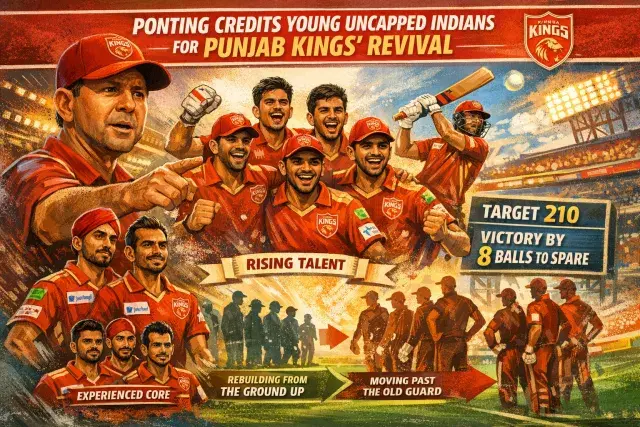
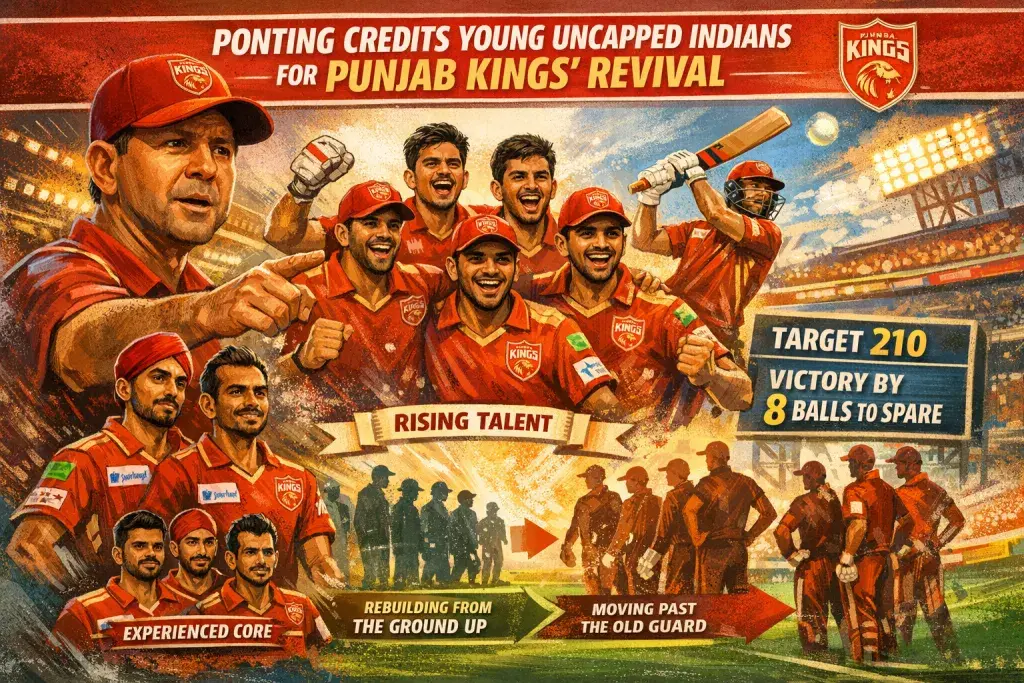
A carefully constructed rebuilding strategy, centred on young uncapped Indian talent rather than established names, delivered Punjab Kings their second win of the Indian Premier League 2026 on Friday, as they overhauled a target of 210 runs against Chennai Super Kings with eight balls to spare. The result affirmed a deliberate directional shift in how the franchise has chosen to build its identity — one that head coach Ricky Ponting described as rebuilding "from the bottom up."
The Philosophy Behind the Rebuild
Franchise cricket has long grappled with a familiar tension: the pull of proven, high-profile names against the volatility — and potential — of younger, lesser-known talent. Punjab Kings have made a clear choice. Speaking to JioHotstar after Friday's result, Ponting was candid about the architecture of the squad. "Some of our young Indian talent, the guys at the top of the order, are pretty special," he said, pointing to Prabhsimran Singh, Priyansh Arya, Shashank Singh, Nehal Wadhera and Vijaykumar Vyshak as central to the vision.
The approach was not accidental. Ponting explained that retaining Prabhsimran Singh and Shashank Singh from the previous cycle gave the franchise an anchor around which to construct a new identity — freeing the coaching staff to pursue players they genuinely wanted, rather than inheriting a roster by default. That kind of deliberate continuity within a largely reset squad is rare in franchise cricket, where auction cycles frequently produce wholesale reinventions with little strategic coherence.
Senior Acquisitions as Structural Support
Building around youth does not mean ignoring experience. Ponting was precise about where senior Indian talent fits into the model. Shreyas Iyer, he said, was "number one on the list" — a high-value acquisition who now captains the side. Arshdeep Singh and Yuzvendra Chahal were identified as essential additions, not for their marketability, but for the quality they bring to specific roles that younger players are not yet positioned to fill.
This layered approach — uncapped batting talent at the top, experienced campaigners providing structural stability — reflects a broader shift in how progressive franchise setups think about squad construction. The instinct to simply purchase the most recognisable names has repeatedly failed to produce sustained success. Punjab Kings' current framework suggests an attempt to break from that pattern by identifying function first and reputation second.
Friday's Performance and What It Demonstrated
The win itself served as a live demonstration of the strategy's early promise. Priyansh Arya, Prabhsimran Singh and Shreyas Iyer provided the principal contributions in the chase. Against a Chennai bowling attack that had restricted batters to 210 from their own innings — boosted significantly by Mhatre's 73, Shivam Dube's unbeaten 45 and a rapid 32 off 12 deliveries from Sarfaraz Khan — Punjab Kings' response was controlled and decisive. The target was reached with delivery to spare, not through scrambling improvisation but through sustained, structured batting.
Ponting acknowledged that winning the toss and electing to field shaped the conditions favourably. "It looked like a belter of a wicket with a little bit of grass on it, something that we're not used to seeing in Chennai," he noted — a reminder that conditions and decisions interact constantly in high-pressure situations, and that preparation for multiple scenarios is itself a form of readiness.
The Road Ahead and the Discipline of Momentum
Consecutive wins early in a long competition carry psychological weight, but Ponting was measured in his response to the result. "We're happy, but you can't afford to be too happy in a tournament like this," he said, already pointing toward the next fixture at Eden Gardens against Kolkata Knight Riders on Monday, which he anticipated would be a high-scoring affair.
That kind of disciplined temperament — acknowledging success without being consumed by it — is itself a hallmark of well-run sporting environments. For a franchise that has historically struggled to convert individual brilliance into collective consistency, the ability to reset quickly between fixtures may matter as much as any individual performance. Punjab Kings have positioned themselves as a franchise with a coherent identity. Whether that identity holds under accumulating pressure is the question the remainder of 2026 will answer.